Favikon vs LinkedIn Creator Campaigns: What Breaks When You Use Instagram-First Tools
Instagram-first influencer tools often fail on LinkedIn. Here’s why LinkedIn creator campaigns need a different approach—and how brands can fix it.
Co-founder @anchors ; Disrupting a $23 billion Industry | NIFT New Delhi
TLDR
- Instagram-first influencer tools break on LinkedIn because they optimize for the wrong signals.
- LinkedIn creator campaigns need relevance, context, and verified reporting.
- Nano and micro LinkedIn creators often outperform larger accounts for B2B brands.
- Run small pilots and use LinkedIn-native platforms to remove guesswork.
This article is written for brands and marketing teams running or planning LinkedIn creator campaigns in B2B industries like SaaS, HRTech, FinTech, and EdTech. If you already use an influencer tool built for Instagram or YouTube and feel it is not working on LinkedIn, you are not alone. Many teams reach this point right before switching tools.
Favikon has invested seriously in LinkedIn, more than most tools in this space. But investment in LinkedIn data coverage is not the same as rearchitecting the scoring logic for how B2B influence actually works. The platform can tell you how many people engaged with a LinkedIn creator's post. It struggles to tell you whether any of them were your buyers
Why LinkedIn Creator Campaigns Behave Differently from Instagram
LinkedIn is not a visual-first, follower-obsessed network. It is a context-first professional network. People open LinkedIn to learn, hire, sell, and build credibility. This changes how creator content performs.
On Instagram, reach is often driven by visuals, trends, and entertainment. On LinkedIn, reach is driven by relevance to professional identity and early engagement from the right audience. A post by a founder, HR leader, or operator can outperform a larger lifestyle creator if the topic aligns with the audience’s job-to-be-done.
This is why Instagram-first influencer tools struggle. They optimize for the wrong signals.
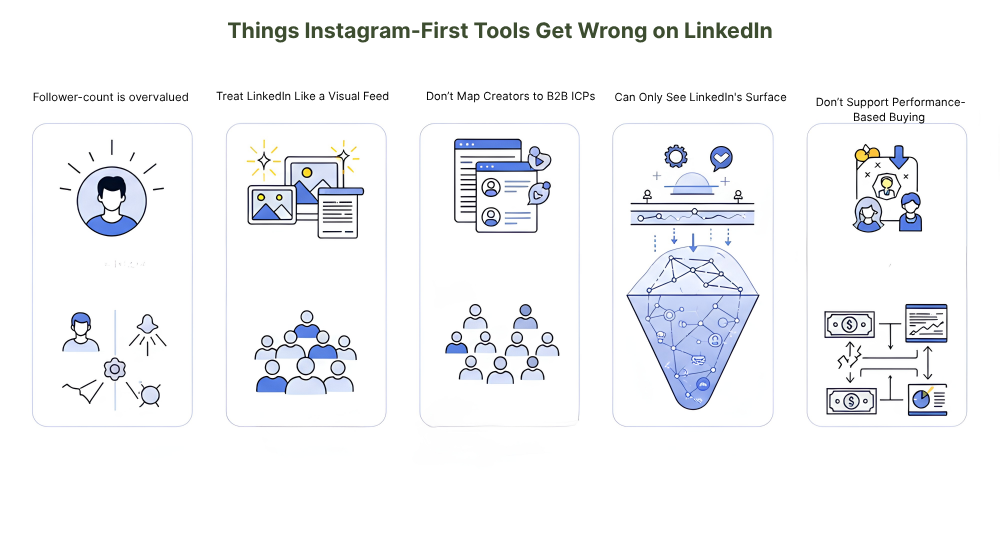
5 Things Instagram-First Tools Get Wrong on LinkedIn
1. They Overweight Follower Count
Most Instagram-first tools rank creators by follower size. On LinkedIn, follower count is a weak predictor of outcomes for B2B brands.
A nano LinkedIn creator with ~1,000–10,000 followers who consistently posts about HR operations or SaaS growth can outperform a creator with 100k followers posting generic motivation.
What breaks: Brands end up paying for reach instead of relevance.
What works on LinkedIn: Consistent topic focus, audience seniority, and comment quality.
- HR leadership creator (~8k followers)
- B2B SaaS operator (~15k followers)
- Founder sharing GTM lessons (~22k followers)
2. They Treat LinkedIn Like a Visual Feed
Instagram-first tools prioritize images, reels, and aesthetic scoring. LinkedIn rewards text-led narratives, document posts, and opinionated takes.
A plain-text post with a strong point of view often outperforms a designed creative on LinkedIn. Instagram-first tools do not model this well.
What breaks: Creators are briefed to “make it look good” instead of “make it useful.”
What works on LinkedIn: Clear POV, lived experience, and professional credibility.
3.They Can Only See LinkedIn's Surface, Not What's Inside It
Instagram-first tools are built on rich data pipelines. Meta has formal API partnerships with influencer marketing platforms, giving them access to verified impressions, story views, audience demographics, and post-level performance data directly from the source.
LinkedIn's data infrastructure works nothing like this.
LinkedIn severely restricts third-party API access. Getting official partner-level data access from LinkedIn is a lengthy approval process that most tools will never complete. What this means in practice: tools like Favikon and most others in the market are working from publicly visible data only. Follower counts, visible engagement numbers, public post reactions. They pull this automatically and systematically, but it is still fundamentally surface-level.
What breaks: Campaign reporting looks fine on paper but cannot answer the only question B2B teams care about, did this reach our buyers?
What works on LinkedIn: Post-level data that surfaces audience seniority, role alignment, and click behaviour, the signals that connect creator activity to pipeline, not just impressions.
4. They Don’t Map Creators to B2B ICPs
Instagram-first tools classify creators by category: marketing, business, lifestyle. B2B brands need more precision.
On LinkedIn, the key question is: Who is reading and engaging with this creator?
Founders, HR heads, CXOs, and operators engage differently. Instagram-first tools rarely surface this nuance.
What breaks: Campaigns get engagement but no qualified conversations.
What works on LinkedIn: Creator selection based on audience role, seniority, and industry alignment.
5. They Don’t Support Performance-Based Buying
Most Instagram influencer tools are built around flat fees. LinkedIn campaigns increasingly move toward CPM- or CPC-style thinking, especially for brands used to paid media.
What breaks: Brands cannot compare creator spend with LinkedIn ads or other channels.
What works on LinkedIn: Treating creator posts like media placements with clear delivery and outcome tracking.
What “Good” LinkedIn Creator Reporting Looks Like
Most B2B marketing teams come to LinkedIn creator campaigns with a paid media mindset, and that instinct is mostly right. The reporting should be structured, comparable across creators, and tied to outcomes rather than vanity numbers.
But LinkedIn creator reporting has one layer that paid media reporting does not: the audience layer. An impression on LinkedIn is not equal to an impression on Instagram. Who saw it matters as much as how many saw it.
Strong LinkedIn creator reporting covers three levels:
Post level: Impressions, clicks, engagement volume, and engagement rate per post. These are the baseline. Without them you cannot compare creator performance or identify which content angles are working.
Audience level: This is where LinkedIn creator reporting diverges from Instagram. Good reporting surfaces who is engaging, for eg: job titles, seniority levels, industries. A post with 300 reactions from founders and VPs of Sales is a fundamentally different result than 300 reactions from students and entry-level professionals, even if the numbers look identical. Most third-party tools cannot surface this because LinkedIn restricts this data to its own native analytics. It is worth knowing whether your reporting source has access to it or is working around it.
Campaign level: Creator-level aggregation and rollups across posts, so you can compare delivery, cost, and outcome across the whole program and not just post by post.
The goal is reporting that lets you make the same decision you would make with a paid media channel: scale what is working, cut what is not, and know why.
How to Pick Creators for B2B Audiences on LinkedIn
For founders, HR teams, and CXOs, creator selection should follow a simple framework.
Start with Role Relevance
Ask: does this creator speak to the same job role you sell to?
- HR SaaS → HR leaders, recruiters, people ops creators
- Developer tools → engineering managers, CTOs, dev advocates
- Founder tools → operators and startup founders
Prefer Nano and Micro Creators
On LinkedIn, nano (~1k–10k) and micro (~10k–50k) creators often drive deeper engagement and more credible conversations.
They post from experience, reply to comments, and feel accessible.
Check Comment Quality, Not Just Volume
Scan comments for job titles and thoughtful replies. A post with 20 comments from founders and managers is often more valuable than one with 200 generic reactions.
A Simple LinkedIn Pilot Plan That Removes Guesswork
If your current tool is failing you, run a small LinkedIn-native pilot before committing more budget.
7-Day Action Plan
- Day 1: Define one ICP and one core message
- Day 2: Shortlist 5–10 nano or micro LinkedIn creators
- Day 3: Brief creators with context, not scripts
- Day 4: Align on posting windows and CTA
- Day 5: Launch posts
- Day 6: Monitor early engagement and comments
- Day 7: Review verified performance data
Using a LinkedIn-specific platform like anchors helps here because creator discovery, briefing, and reporting are designed for this exact workflow.
Decision Matrix: Choosing the Right Creator Tier on LinkedIn
Breakdown by Tier
Nano creators
- Goal: Early pilots.
- Use Case: Ideal when you need to build initial, grassroots credibility.
- Avoid When: Your primary goal is massive, immediate reach.
- Metrics: Comments, clicks.
- Watch Out: Avoid over-briefing them; highly scripted content kills the authenticity that makes them effective.
Micro creators
- Goal: Scaled tests.
- Use Case: Works best when there is a strong, validated fit with your target audience.
- Avoid When: Your core message or campaign angle is vague.
- Metrics: Click-Through Rate (CTR), engagement.
- Watch Out: Don't make the mistake of paying for raw follower counts rather than genuine community influence.
Macro creators
- Goal: Awareness.
- Use Case: Perfect when the brand is already well-known and simply needs broader top-of-funnel visibility.
- Avoid When: Your Ideal Customer Profile (ICP) is highly narrow or specialized.
- Metrics: Impressions.
- Watch Out: Don't ignore audience relevance just to get your name in front of a larger, but potentially uninterested, crowd.
Realistic LinkedIn Campaign Examples
Example 1: HR SaaS
Objective: Reach HR leaders.
Creator type: HR leadership nano creators.
Content angle: Hiring process mistakes.
Success: Consistent engagement and {{qualified_leads}}.
Example 2: Founder Tool
Objective: Founder awareness.
Creator type: Micro founders.
Content angle: Operator lessons.
Success: Strong comments and {{signups}}.
Mistakes We’ve Seen Brands Make
- Using Instagram benchmarks on LinkedIn
- Optimizing for likes instead of conversations
- Overpaying large creators with weak relevance
- Not testing before scaling
Where anchors Fits (and When It Won’t)
anchors is best when brands want to run LinkedIn creator campaigns like ads: measurable, repeatable, and grounded in verified data.
It may not be a fit if you are looking for purely aesthetic content or entertainment-driven reach. It is designed for teams who care about performance and B2B outcomes.
If you are at the point where your current tool feels wrong for LinkedIn, that is usually the right time to evaluate a LinkedIn-native platform.
Explore More Articles
Discover our latest insights on SEO, content marketing, and digital strategy. Explore our curated collection of articles to enhance your digital presence.
← Scroll to explore more →