How Much Does LinkedIn Influencer Marketing Cost in India (2026)?
Co-founder @anchors ; Disrupting a $23 billion Industry | NIFT New Delhi
You have a budget approved, a brief half-written, and a LinkedIn influencer campaign you need to run. Then the agency quotes arrive and suddenly the numbers look completely different depending on who you ask. One agency quotes ₹8L for 10 creators. Another quotes ₹15L for the same scope. A third cannot tell you what the creator gets paid versus what the agency keeps.
This is not because LinkedIn influencer marketing pricing in India is genuinely complicated. It is because there is no standard benchmark in this space across the globe, and very little transparency about where your money actually goes. This blog gives you the real numbers, the full cost structure, and a framework to pressure-test any quote you receive.
What You Are Actually Paying For (Hint: It Is Not Just the Creator Fee)
When brands try to calculate LinkedIn influencer marketing cost in India, they focus on the influencer's post fee. That is one part of the bill. The full cost has at least 2 more layers that most agencies do not show you upfront.
The influencer's post fee
Influencer fees in the Indian LinkedIn market vary significantly by tier.
- Nano creators (1,000 to 10,000 followers) typically charge ₹2,000 to ₹7,000 per sponsored post.
- Micro creators (10,000 to 100,000 followers) range from ₹5,000 to ₹55,000.
- Macro creators (100,000 to 500,000 followers) charge ₹40,000 to ₹3,00,000 per post.
- Mega creators above 500,000 followers charge ₹3,00,000 and above, with considerable variation depending on engagement quality, content niche, and audience demographics.
These are single-post rates — campaigns requiring multiple posts or formats or ad rights are priced separately.
The agency layer on top
This is where pricing becomes opaque. Agencies in India typically take 30 to 75% of the total campaign cost as their management fee. If a brand pays ₹10,00,000 for a campaign, ₹3,00,000 to ₹7,50,000 of that goes to the agency.
The remaining amount covers actual creator fees.
Brands rarely receive a line-item breakdown of what the agency keeps versus what the creator is paid. The creator often has no idea what the brand's total spend was.
anchors eliminates this layer entirely — the platform handles creator selection, brief generation, and campaign activation automatically, with no agency markup sitting on top.
The reach you are paying for but cannot verify
From working across dozens of LinkedIn influencer campaigns, the verification problem is consistent: 90% of campaign reports rely on screenshots that influencers send after posting.
The underlying data is private. There is no independent validation that the impression/member reach numbers shown are accurate. For a deeper look at how this plays out in practice, read this. It covers the mechanics of the problem and what verified data actually looks like.
Typical LinkedIn Influencer Marketing Pricing in India
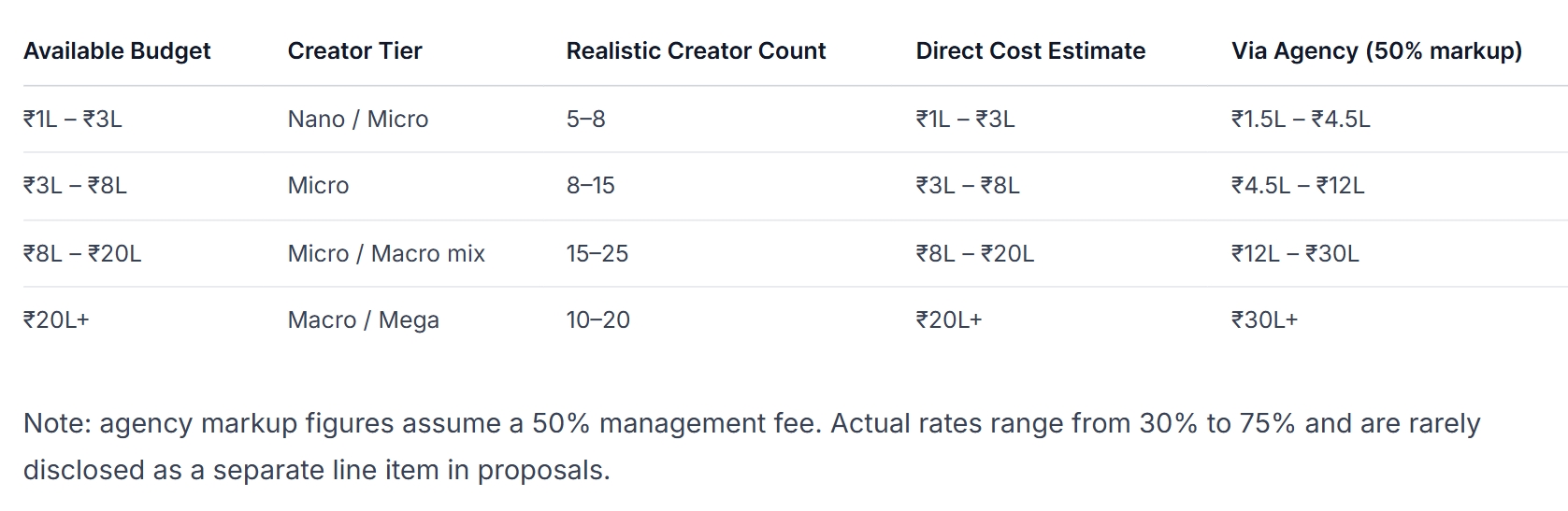
These are benchmarks based on market rates, not guarantees. Actual campaign costs depend on creator selection criteria, content requirements, exclusivity terms, and whether the brand is going through an agency or a platform. The 50% agency markup used here is the midpoint of the 30–75% range typical in the Indian influencer marketing market.
On anchors, brands see the creator count, expected reach, and collaboration cost before committing any budget.
A campaign with 10 micro creators that costs ₹5L to ₹11L through an agency can be activated closer to the baseline creator fee on the platform.
Get a campaign estimate — creators, expected reach, and cost — before committing a rupee. Try anchors
Why Agency Fees for LinkedIn Campaigns Are Hard to Justify at Scale
The agency markup exists because of manual operational process, not managed expertise. Sourcing involves working through an existing roster or calling multiple other agencies and freelancers for introductions.
Briefing involves writing one document. Execution follow-up is WhatsApp messages and calls to creators to ensure everything is on time. Reporting is collecting screenshots and converting the numbers from them into a deck/sheet.
This chain, for a 10-creator micro campaign, takes agencies 11 to 14 days on average from briefing to go-live. The brand pays 30 to 75% of total spend for this timeline.
The scale problem is real. A brand that wants 50 or 100 creators cannot get that through an agency without the overhead increasing proportionally. The process does not scale automatically. It scales by adding more headcount. Platforms scale with much more ease because the operational layer is automated.
For a detailed breakdown of how the 2 models compare on cost, speed, and transparency, read this. It will walk you through the structural differences side by side.
What Most Brands Get Wrong When Budgeting for LinkedIn Campaigns
The 1st mistake is optimizing the budget around follower count instead of audience fit.
A macro creator with 200,000 followers in a general business niche costs 3-5 times more than a micro creator with 45,000 followers whose audience is 65% senior managers and founders in fintech. For B2B campaigns where the target buyer is a specific job title or seniority level, the micro creator often delivers more relevant reach per rupee. How to target decision-makers on LinkedIn with influencer marketing covers how to evaluate audience fit before selecting or paying for any creator.
The 2nd mistake is not accounting for the full all-in cost. The ₹10L campaign rarely costs ₹10L once agency fees, brief revisions, content retakes, and reporting are included. Brands that budget only for creator fees are consistently surprised by the final invoice.
The 3rd mistake is paying before knowing what the campaign will deliver. Committing ₹5L or ₹10L without a data-backed reach estimate, creator breakdown, or cost-per-impression benchmark means approving a budget with no performance anchor to measure against.
Campaign Budget Planning Reference
Use this table before approaching any agency or platform:
If you want to double-check, request the influencer rate sheet and cross-verify it directly with the influencers. This will allow you to see exactly what the agency markups are
Explore More Articles
Discover our latest insights on SEO, content marketing, and digital strategy. Explore our curated collection of articles to enhance your digital presence.
← Scroll to explore more →