LinkedIn Creators vs LinkedIn Ads for B2B: When to Use Which (and a Simple Hybrid Pilot)
Founders and B2B marketers often debate creators vs ads on LinkedIn. This guide breaks the trade-offs, red flags, and a simple hybrid pilot you can run in 2 weeks.
Co-founder @anchors ; Disrupting a $23 billion Industry | NIFT New Delhi
TLDR
- LinkedIn Ads are best for demand capture and scale.
- LinkedIn creators are best for trust, education, and influence.
- A 2-week hybrid pilot helps you learn fast with less risk.
- Measure creators and ads together, not in isolation.
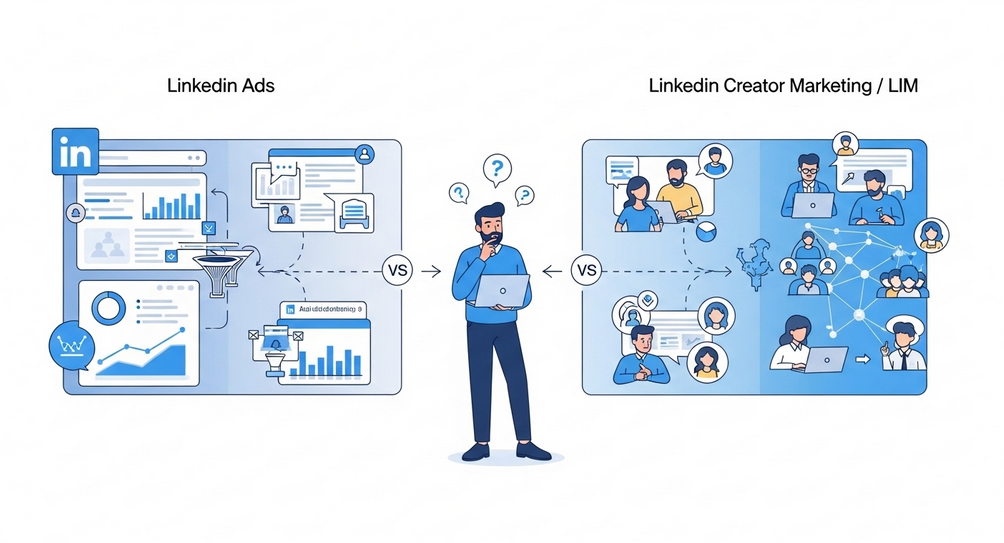
If you are a B2B founder or marketer selling to working professionals, decision-makers, or enterprise buyers, you have likely faced this exact question: Should we put our next budget into LinkedIn Ads or work with LinkedIn creators? This is not just a channel debate. It is about trust vs scale, storytelling vs targeting, and predictability vs authenticity. In this blog, written specifically for brands running B2B campaigns, we will break down what each approach is best at, when it fails, and how to combine both into a simple hybrid pilot you can test without overthinking.
Why This Debate Matters for B2B Brands
B2B buying cycles are long, crowded, and driven by credibility. Your audience is not impulse-buying. They are comparing tools, asking peers, and forming opinions over weeks or months. LinkedIn Ads give you control and scale. LinkedIn creators give you context and trust. Treating them as substitutes is where most brands go wrong.
Performance-driven platforms like anchors exist because brands want influencer marketing to behave more like ads: measurable, predictable, and tied to real LinkedIn data rather than screenshots. Understanding where creators and ads fit in the funnel helps you avoid wasted spend.
What LinkedIn Ads Are Best At
LinkedIn Ads work best when you need consistency and targeting precision. You are buying attention, not relationships.
- Clear demand capture: Retargeting site visitors, demo viewers, or existing leads.
- Precise ICP targeting: Job titles, seniority, company size, and industry filters.
- Predictable scale: You can increase budget and get more impressions quickly.
- Controlled messaging: One narrative, one landing page, one CTA.
For brands with a proven funnel and strong landing pages, ads are often the backbone. But ads struggle to create belief when the brand is new or the category is complex.
What LinkedIn Creators Are Best At
LinkedIn creators shine when your product needs explanation, credibility, or a human voice. You are borrowing trust, not just reach.
- Category education: Explaining a new workflow, tool, or way of thinking.
- Social proof: “People like me are talking about this.”
- Top and mid-funnel influence: Shaping opinions before buyers search.
- Native distribution: Content blends into the feed instead of feeling like an ad.
Typical creator tiers on LinkedIn include nano creators (~1,000–10,000 followers) and micro creators (~10,000–50,000 followers). These creators often have highly focused audiences like founders, HR leaders, or product managers.
Generic examples include: Product leadership creator (~6k followers), HR leadership creator (~8k followers), B2B growth creator (~22k followers).
When LinkedIn Creators Make Sense (5 Signals)
- You are early in the market: Few people search for your category yet.
- Your ICP trusts peers more than brands: Founders, operators, and specialists.
- Your product needs nuance: One ad cannot explain it fully.
- You want inbound demand: Comments, DMs, and profile visits matter.
- You want long-tail impact: Posts keep getting engagement over time.
On platforms like anchors, brands can run creator campaigns using CPM or CPC-style models, making creators easier to compare with ads without turning it into guesswork.
When LinkedIn Creators Won’t Work (5 Red Flags)
- You need instant pipeline: Creators rarely deliver same-day demos.
- Your ICP is extremely niche: Very specific job + industry combinations.
- You cannot brief clearly: Vague messaging leads to weak posts.
- You expect full control: Creator content is not banner ads.
- You measure only last-click: Creator impact is often assisted, not final.
Decision Matrix: Creators vs Ads vs Hybrid
Breakdown by Option
LinkedIn Ads
- Goal: Demand capture.
- Use Case: Ideal when you have a clear Ideal Customer Profile (ICP) and an established conversion funnel.
- Avoid When: The category is unknown and requires heavy audience education.
- Metrics: Click-Through Rate (CTR), Cost Per Click (CPC), and demos booked.
- Watch Out: Don't make the mistake of scaling your ad spend before you have validated message-market fit.
LinkedIn Creators
- Goal: Trust and education.
- Use Case: Works best when your target ICP actively follows and engages with industry creators.
- Avoid When: You are expecting instant, direct-response ROI.
- Metrics: Engagement, profile visits.
- Watch Out: Avoid picking creators solely based on their follower count; prioritize audience alignment.
Hybrid
- Goal: Balanced growth.
- Use Case: Perfect when organic creator content builds trust and feeds directly into your paid ad retargeting funnels.
- Avoid When: You have no tracking alignment set up between your organic and paid efforts.
- Metrics: Assisted conversions.
- Watch Out: Do not treat organic and paid channels in isolation; they must function as a cohesive ecosystem.
A Simple 2-Week Hybrid Pilot Plan
This is designed for brands that want learning, not perfection.
Week 1: Creator Seeding
- Pick 3–5 nano or micro creators aligned with your ICP.
- Brief them on one clear problem and insight, not features.
- Let creators publish native posts sharing their perspective.
Week 2: Ads Amplification
- Boost top-performing creator posts via ads.
- Retarget users who engaged with creator content.
- Send traffic to a focused landing page.
Platforms like anchors simplify this by handling creator selection, performance tracking, and verified LinkedIn reporting in one place.
How to Estimate Budget and Creators Needed
- Start small: one objective, one ICP.
- Split budget: ~50% creators, ~50% ads for the pilot.
- Prioritize consistency over volume.
- Measure directional signals, not final ROI.
Mini Pilot Planner (Copy This)
Objective: ____________________
Budget: ____________________
ICP: ____________________
Creator type: Nano / Micro
Content angle: ____________________
Success signal: {{engagement}} / {{CTR}} / {{qualified_leads}}
CTA: Generate campaign
Realistic Mini Examples
- HR SaaS: Objective: awareness. Creator type: HR leadership creator (~8k followers). Content angle: common hiring mistakes. Success: {{engagement}}.
- B2B Course: Objective: signups. Creator type: career creator (~15k followers). Content angle: skill gaps. Success: {{signups}}.
Mistakes We See Brands Make
- Comparing creator posts directly to search ads.
- Over-briefing creators with brand jargon.
- Ignoring comments and DMs.
- Stopping after one post.
- Not aligning ads and creators.
Explore More Articles
Discover our latest insights on SEO, content marketing, and digital strategy. Explore our curated collection of articles to enhance your digital presence.
← Scroll to explore more →