LinkedIn Influencer Marketing Agency vs Platform: An Honest Comparison for B2B Brands
Co-founder @anchors ; Disrupting a $23 billion Industry | NIFT New Delhi
You have a campaign brief, a budget approved, and a decision in front of you: agency or platform for your LinkedIn influencer marketing.
Both options exist.
Both have trade-offs.
What most content on this topic gets wrong is that it is usually written by an agency or a platform, so the comparison always tilts in a predictable direction. The goal here is a straightforward breakdown of the LinkedIn influencer marketing agency vs platform choice, using what the process actually looks like in practice, not the marketing version of either model.
What Working with a LinkedIn Influencer Marketing Agency Actually Involves
An agency campaign on LinkedIn starts with a briefing call, followed by sourcing. The agency goes to its roster which includes a mix of direct relationships and indirect network connections through partner agencies, to find creators who might fit the brief. After recommending them to the client (a.k.a brand), and getting approvals on the profiles, each creator needs to be contacted, rates negotiated, briefs written, approval rounds managed, and sign-offs collected.
In practice, a LinkedIn influencer campaign with 10 creators takes an agency between 11 and 14 days from profile approvals to live. With 25 creators, that stretches to 3-4 weeks. Every step in the process requires a human in the middle, and that human has competing priorities across other campaigns and clients they are managing.
The cost structure deserves a close look too. Brands typically see an agency management fee of 10 to 15% of the total campaign value. What is invisible is the margin agencies take from the creators' payouts.
After working across both the influencer and brand sides of campaigns over three years, a consistent pattern emerges: agencies mark up creator fees by 30 to 75% above what the creator actually receives.
If a brand believes they are paying ₹40,000 per post to a creator, the creator may be receiving only ₹15,000 to ₹25,000 of that. Both parties are often unclear on exactly how this split works. This is not a hidden conspiracy. Ask any creator who has worked with agencies. It is how agency economics function structurally across the influencer industry, including on LinkedIn. It's how they are able to sustain else a 10% management fee is nowhere near enough a business to survive.
Let's look at reporting and performance tracking next.
Reporting at the end of a campaign arrives as a deck/excel sheet compiled from screenshots that creators share privately after a campaign ends. Screenshots are the only way because LinkedIn does not allow third-party access to post analytics without the creator linking their account. This is standard practice, hardly ever questioned.
However, the catch here is that there's no way to check the verity of those screenshots. With AI image editing capabilities, it has become a bit too easy to edit numbers that make a creator look bad, with none the wiser.
how to run a LinkedIn influencer campaign without an agency
What a LinkedIn Influencer Marketing Platform Does Differently
A platform removes the intermediary from the process. Brands work with a system, not a service relationship, to identify, brief, and activate creators.
On anchors, for example, a brand inputs 3 things: their domain, product details, and budget. The algorithm surfaces matched creators within that budget and shows the expected campaign reach before any payment is committed. Creators on anchors have synced their LinkedIn accounts directly, which means their audience demographics, follower counts, and engagement data come from LinkedIn itself, not from screenshots or self-reported files.
The collab library on the platform shows past brand collaborations for every creator, similar to how the LinkedIn Ads Library shows active ad campaigns, or a Meta ads library does.
When creators are confirmed by the brand, anchors generates a personalized (editable) brief for each one automatically. No individual brief writing. No price negotiation. No email follow up threads.
The Cost Comparison: Where the Real Numbers Are
Agency pricing looks clean on paper until the full structure is visible. The management fee is explicit. The creator-side markup is not.
A brand running a ₹10 lakh campaign with 25 creators, at a 40% agency margin baked into creator fees, is effectively receiving significantly less reach than they paid for based on the self-reported metrics. The creators receive less than the brand intended to pay them. Both parties are working from incomplete information.
Platform pricing works from the opposite direction. On anchors, the collaboration charge per creator is visible before commitment. The expected reach per creator is shown before payment. There is no hidden layer between what the brand spends and what the creator receives. The total cost of the campaign, and what it will produce, is visible at the point of decision.
One anchors campaign ran with 25 creators and went live in under 6 hours. That is not the standard but it shows the ceiling of what becomes possible when creator data is pre-verified and other operational manual steps are automated. For brands used to waiting 3 weeks to see their campaign activate, the difference is structural, not marginal.
Get a campaign estimate — creators, reach, and cost — before committing a rupee. Try anchors
Speed and Transparency: The 2 Metrics Agencies Don't Publish
Ask an agency how long their average LinkedIn campaign takes from brief to live. Most will not give a number because the answer does not help them. The structure of agency work, human-to-human sourcing, negotiation, approval rounds, means timelines are inherently variable. Fourteen days is realistic. 3 weeks is common for anything at scale.
Timelines through a platform are different because the onus is on you, the brand, for whom this takes priority. To move even faster, creators are pre-onboarded. Data is already verified. The best prices are already defined. Briefs are generated by the system. The coordination work that takes an agency two weeks takes the platform hours.
On reporting transparency: LinkedIn does not expose post analytics to third parties without direct account syncing. Agencies work around this by asking creators to share screenshots. From what anchors has seen running campaigns across multiple sectors on LinkedIn, approximately 90% of influencer impression data shared in the industry cannot be independently confirmed by the brand receiving it. That does not mean every number is fabricated but enough numbers are to make you wonder the authenticity of every single one. It means the brand is knowingly, blindly trusting a easily manipulable screenshot, not the source-of-truth. 90% of LinkedIn influencer screenshots are fake — here's how to verify
anchors uses synced LinkedIn data. The numbers that inform creator selection, expected reach, and post-campaign reporting come directly from LinkedIn. Not from a manually exported file. Not from a screenshot the creator took this morning.
When an Agency Still Makes Sense
Agencies are not the wrong choice in every situation. There are specific cases where the agency model provides real value.
If a campaign spans multiple channels simultaneously — LinkedIn, Instagram, YouTube, podcast sponsorships — and needs coordinated creative direction across all of them, an agency with multi-channel relationships can manage that. If a brand needs celebrity-level talent with complex deal structures and legal riders, the relationship-led agency model is suited to it. If there is zero internal marketing ops bandwidth and the brand needs a fully managed service with creative strategy included, an agency absorbs that operational load.
For LinkedIn-specific campaigns with B2B audiences and data requirements, the agency model's structural advantages shrink considerably against what a purpose-built platform offers.
When a Platform Is the More Practical Choice
For B2B SaaS, fintech, HR tech, and similar categories where the target audience is active on LinkedIn and trust matters before a purchase decision, a platform built specifically for LinkedIn creator campaigns is structurally better suited than an agency managing multiple channels from a spreadsheet. It's faster, more transparent, and more cost-efficient. The data is verified before a rupee is spent. The brief is automated. The campaign can go live in <24 hours.
Brands running their first LinkedIn influencer campaign often find the platform model easier to justify to internal stakeholders, because the reach and cost are visible before the spend is approved, with almost no overheads. That transparency matters when someone is defending a campaign budget in front of a CFO.
Comparison at a Glance
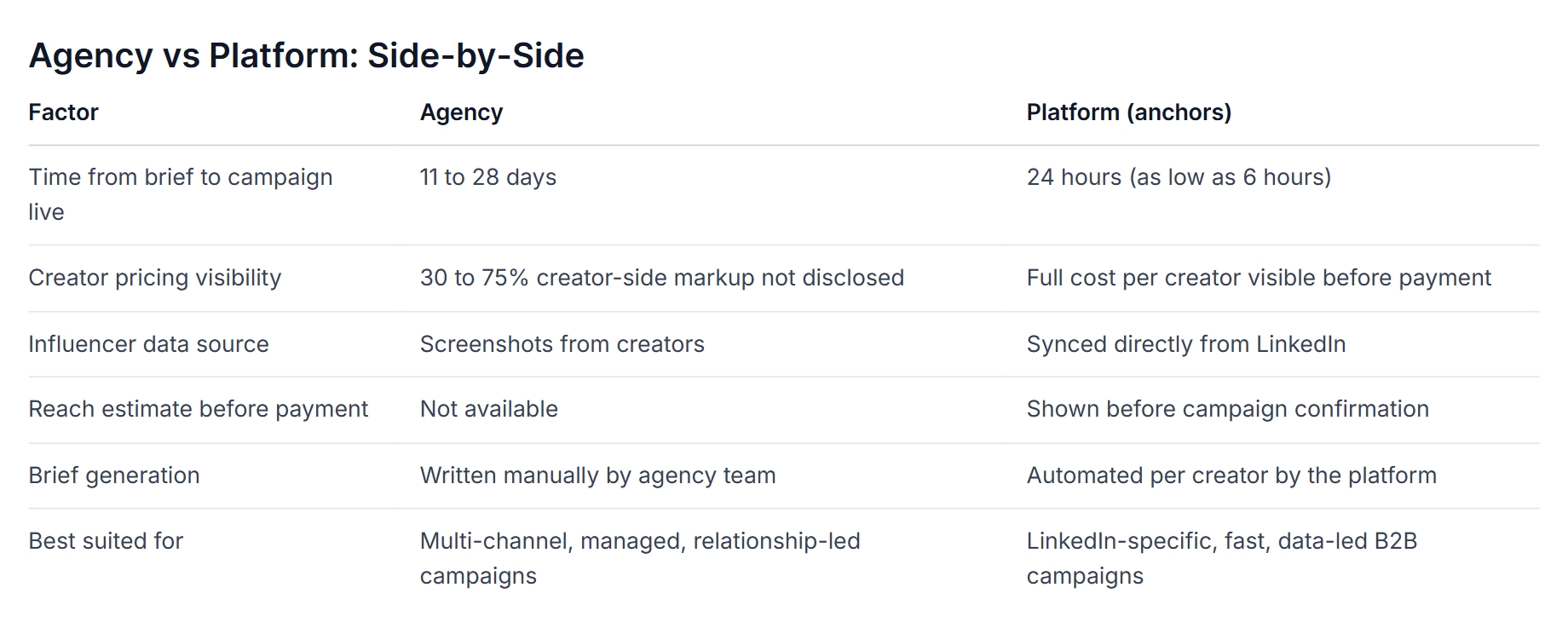
This is the comparison as it actually functions in practice.
Explore More Articles
Discover our latest insights on SEO, content marketing, and digital strategy. Explore our curated collection of articles to enhance your digital presence.
← Scroll to explore more →