“Our brand is new”, should we start with micro creators to build credibility first?
A practical playbook for new brands wondering whether micro LinkedIn creators are the safest way to build trust with a professional audience.
Co-founder @anchors ; Disrupting a $23 billion Industry | NIFT New Delhi
TLDR
- Micro creators can help new brands build early credibility on LinkedIn
- They work best for trust-heavy categories and message testing
- Organic-only approaches are risky and slow
- Treat creator campaigns like ads using measurable execution, as enabled by platforms like anchors
This question comes up almost every time a new brand considers LinkedIn creator marketing. If you are a brand targeting a professional audience and you feel unknown, unproven, or early-stage, starting with micro creators feels safe. But is it always the right move? In this guide, we break down when micro creators genuinely help build credibility, when they slow you down, and how to approach creator campaigns in a predictable, measurable way.
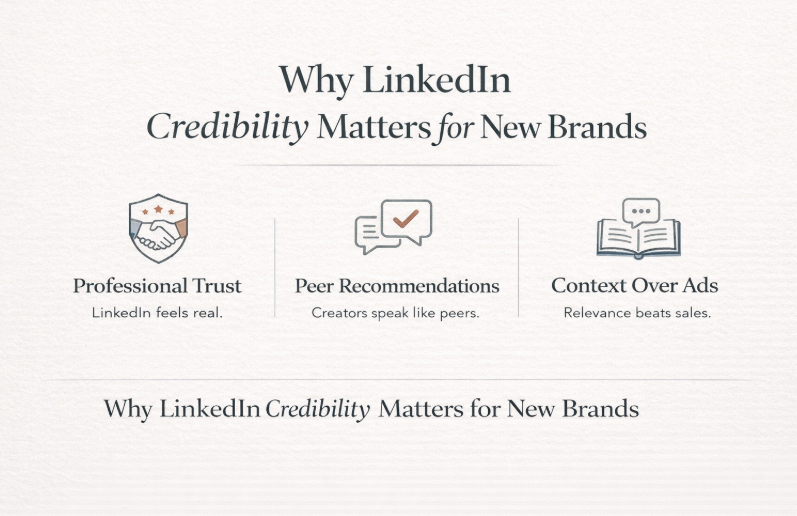
Why new brands worry about credibility on LinkedIn
LinkedIn is not Instagram or YouTube. People come here to protect their professional reputation. They are cautious about what they believe, share, and buy.
For a new brand, this creates three common fears:
- “No one knows us yet.”
- “Big creators won’t take us seriously.”
- “Our ads will feel too salesy.”
That is why micro creators are often seen as the credibility bridge. They feel closer to the audience, more authentic, and more approachable.
What do we actually mean by micro creators on LinkedIn?
Before deciding, it helps to align on definitions. On LinkedIn, creator tiers look different from other platforms.
- Nano creators: ~1,000–10,000 followers. Often niche experts or early voices.
- Micro creators: ~10,000–50,000 followers. Consistent content, strong community trust.
- Mid-tier creators: ~50,000–200,000 followers. Broader reach with authority.
Examples of micro or nano creators (generic):
- HR leadership creator (~8k followers)
- Start-up operations creator (~15k followers)
- B2B marketing practitioner (~22k followers)
These creators are not celebrities. They are respected peers.
The real reason micro creators build credibility
Micro creators do not magically make a brand trustworthy. They work because of context transfer.
When a respected creator talks about your product or idea, their audience borrows trust from the creator and temporarily lends it to you.
This works best when:
- The creator already speaks about the problem you solve
- The content feels educational, not promotional
- The brand message fits naturally into their voice
If these conditions are missing, even micro creators will not help.
When starting with micro creators makes sense
For new brands, micro creators are a strong starting point in specific situations.
1. You are entering a trust-heavy category
If your product impacts careers, money, or long-term decisions, trust matters more than reach.
Micro creators allow slower, deeper storytelling that helps explain why your brand exists.
2. You need message validation before scaling
Early campaigns should teach you which angles resonate. Micro creators help you test positioning without large budgets.
3. You want comments and conversations, not just impressions
Micro creators often drive higher-quality discussions. These comments become social proof for your brand page and future ads.
When micro creators are not enough
Starting with micro creators is not a rule. It is a tool.
1. If your goal is fast awareness
Micro creators build trust slowly. If you need visibility across a large professional audience quickly, you will hit a ceiling.
2. If you rely only on organic posting
Organic creator posts alone are unpredictable. Some perform well, others disappear. New brands often mistake silence for failure.
3. If you cannot measure outcomes
Credibility without measurement becomes guesswork. Screenshots and vanity metrics will not help you decide what to scale.
Micro creators vs other options: a quick decision matrix
Micro creators
- Goal: Early credibility.
- Use Case: Ideal when there is a clear niche fit for your product.
- Avoid When: You need fast scale immediately.
- Metrics: Engagement, Click-Through Rate (CTR), saves.
- Watch Out: Don't overvalue follower count; focus on engagement depth.
Mid-tier creators
- Goal: Awareness + trust.
- Use Case: Works best when your message is clear and straightforward.
- Avoid When: Your brand story is weak or undefined.
- Metrics: Reach, CTR.
- Watch Out: Avoid one-off collaborations; they rarely build sufficient momentum.
Paid LinkedIn ads
- Goal: Predictable reach.
- Use Case: Highly effective when you have a strong landing page.
- Avoid When: You have no social proof (testimonials, reviews) to back up the ads.
- Metrics: Cost Per Click (CPC), conversions.
- Watch Out: Don't ignore creative fatigue; ads need regular refreshing to stay effective.
The smarter approach: treat micro creators like ads
The biggest shift new brands need is mindset. Creator marketing should not feel like a gamble.
This is where platforms like anchors quietly change the game. Instead of chasing creators manually, brands can run performance-based LinkedIn creator campaigns that feel closer to ads.
With anchors:
- Brands work with vetted LinkedIn creators
- Campaigns can run on CPM or CPC models
- Reporting is based on verified LinkedIn data
This matters because credibility is not just who says it, but how consistently it shows up.
A simple 7-day playbook for new brands
- Day 1–2: Define one core audience problem you solve
- Day 2–3: Shortlist 5–10 nano or micro creators in that niche
- Day 3–4: Brief creators with one clear content angle
- Day 4–5: Launch posts with performance tracking
- Day 6: Identify top-performing content
- Day 7: Decide what to amplify or repeat
This keeps credibility-building structured instead of emotional.
Templates you can copy
Creator brief template
Audience problem: [one sentence]
Brand context: [why you exist]
Content angle: [story, lesson, or insight]
CTA: [soft action, not sales]
Tracking checklist
Creator name | Followers | Content type | Engagement | CTR | Notes
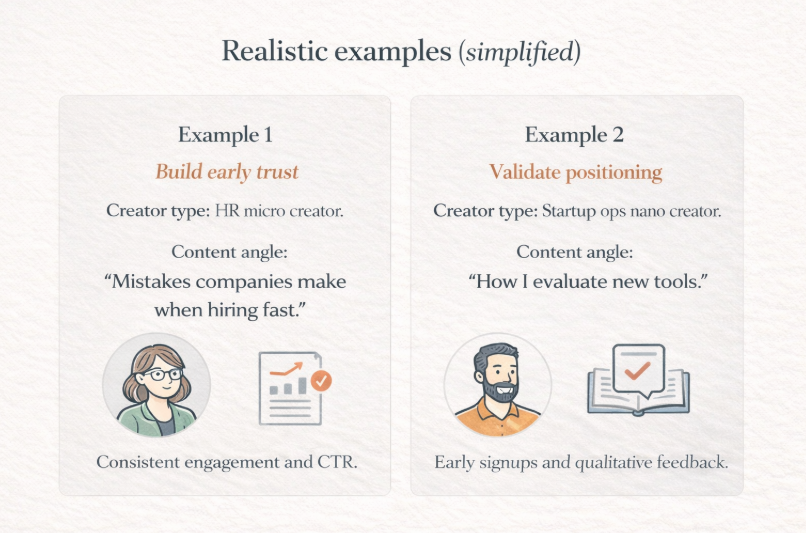
Realistic examples (simplified)
Example 1: Objective: Build early trust.
Creator type: HR micro creator.
Content angle: “Mistakes companies make when hiring fast.”
Result: Consistent engagement and {{CTR}}.
Example 2: Objective: Validate positioning.
Creator type: Startup ops nano creator.
Content angle: “How I evaluate new tools.”
Result: Early {{signups}} and qualitative feedback.
Mistakes we see new brands make
- Choosing creators only by follower count
- Expecting instant conversions
- Using the same brief for every creator
- Ignoring comments and replies
- Not tracking performance consistently
So, should you start with micro creators?
Yes, if you use them intentionally. No, if you treat them as a shortcut.
Micro creators help new brands borrow trust, test messages, and start conversations. But credibility compounds only when execution is repeatable and measurable.
That is why many brands eventually move to structured creator campaigns using platforms like anchors, where influencer marketing feels less like guesswork and more like performance marketing.
Explore More Articles
Discover our latest insights on SEO, content marketing, and digital strategy. Explore our curated collection of articles to enhance your digital presence.
← Scroll to explore more →