Should We Run Creators in Tier 3 Cities? When Hyperlocal LinkedIn Influence Works
A practical guide for brands deciding if Tier 3 LinkedIn creators can drive trust, relevance, and measurable outcomes.
Co-founder @anchors ; Disrupting a $23 billion Industry | NIFT New Delhi
TLDR
- Tier 3 LinkedIn creators work best for hyperlocal trust and niche professional audiences.
- They are ideal when relevance matters more than reach.
- Brands should test with small, measurable campaigns.
- anchors helps simplify discovery, tracking, and performance-based execution.
This question comes up often for brands exploring LinkedIn creator marketing in India: “Do Tier 3 city creators really work, or should we stick to metro voices?” The short answer is: Tier 3 LinkedIn creators can work very well, but only in specific scenarios. This article breaks down when hyperlocal LinkedIn influence makes sense, when it does not, and how brands can approach it in a structured, measurable way without turning it into a manual experiment.
We are writing this specifically for brands evaluating creator-led campaigns on LinkedIn, especially those targeting professionals, founders, operators, and decision-makers across India beyond Tier 1 and Tier 2 cities.
What Do We Mean by Tier 3 LinkedIn Creators?
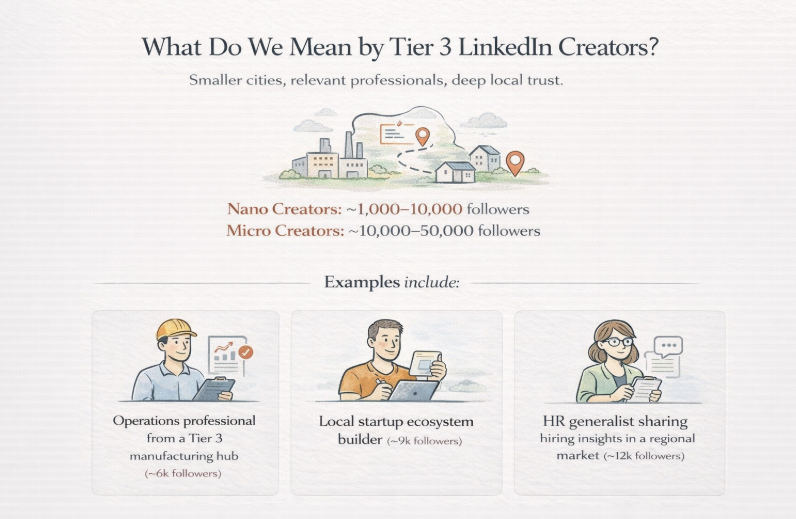
Tier 3 cities are smaller cities and towns with growing professional ecosystems. On LinkedIn, creators from these regions often have deep trust within a narrow, relevant audience, even if their overall follower count looks modest.
In terms of creator size on LinkedIn, brands usually see:
- Nano creators: ~1,000–10,000 followers
- Micro creators: ~10,000–50,000 followers
Most Tier 3 creators fall into the nano or early micro category. Their strength is not reach at scale, but contextual relevance.
Generic examples (not real names):
- Operations professional from a Tier 3 manufacturing hub (~6k followers)
- Local startup ecosystem builder (~9k followers)
- HR generalist sharing hiring insights in a regional market (~12k followers)
Why Brands Are Even Considering Tier 3 Creators
Brands are exploring Tier 3 LinkedIn creators for three main reasons:
- Hyperlocal trust: These creators speak the same language (sometimes literally) as their audience.
- Niche professional clusters: Certain roles and industries are concentrated outside metros.
- Lower noise: Audiences in Tier 3 cities are less saturated with brand messaging.
On LinkedIn especially, credibility matters more than polish. A creator posting from lived experience often outperforms a generic brand post in terms of attention and conversation quality.
When Tier 3 LinkedIn Creators Work Well
Tier 3 creators are not a universal solution. They perform best in the following scenarios.
1. When Your Product or Service Is Used Locally
If adoption or buying decisions happen at a local or regional level, Tier 3 creators can be extremely effective.
Examples include:
- B2B tools used by regional sales teams or operators
- Education or upskilling programs with local centers
- Hiring platforms targeting non-metro talent pools
Here, relevance beats scale.
2. When Trust Is a Bigger Barrier Than Awareness
In many Tier 3 markets, the problem is not that people have never heard of your category. The problem is skepticism.
Creators who are known locally reduce perceived risk by saying, “I’ve seen this work” or “This fits how we operate here.”
3. When You Want Niche Professionals, Not Everyone
Tier 3 creators often attract very specific audiences:
- Plant managers
- Regional HR heads
- Small factory owners
- Local founders and operators
If your ICP looks like this, a metro influencer with 200k followers may be less useful than five regional creators with 8k followers each.
When Tier 3 LinkedIn Creators Usually Don’t Work
It is equally important to know when not to invest here.
1. Pure Top-of-Funnel Brand Awareness at Scale
If your only goal is mass visibility across India, Tier 3 creators alone will not deliver enough reach.
2. Highly Centralized Buying Decisions
If decisions are made only at HQ or by metro-based leadership, regional influence may not move the needle.
3. If You Can’t Measure Beyond Likes
Tier 3 campaigns fail most often when brands rely on screenshots or vanity metrics. Without verified data, it becomes hard to justify continued investment.
Decision Matrix: Should You Use Tier 3 Creators?
Tier 3 Nano Creators
- Goal: Hyperlocal trust.
- Use Case: Best when your audience is tightly defined geographically or demographically.
- Avoid When: You need mass reach immediately.
- Metrics: Clicks, profile visits, comments.
- Watch Out: Do not judge them by follower count alone; look at engagement depth.
Tier 3 Micro Creators
- Goal: Regional scale.
- Use Case: Effective for targeting multiple towns within a specific belt or region.
- Avoid When: Your message is too generic to resonate locally.
- Metrics: Click-Through Rate (CTR), qualified leads.
- Watch Out: Avoid using brand-heavy scripts that sound unnatural.
Tier 1 + Tier 3 Mix
- Goal: Balanced campaigns.
- Use Case: Ideal when you need both the credibility of big names and the trust of locals.
- Avoid When: Your budget is too small to sustain both tiers effectively.
- Metrics: Cost Per Mille (CPM), Cost Per Click (CPC), engagement quality.
- Watch Out: Ensure you define a clear role for each tier to avoid overlapping messaging.
How anchors Helps with Tier 3 Creator Campaigns
One of the biggest challenges with Tier 3 LinkedIn creators is operations: discovery, coordination, and clean reporting.
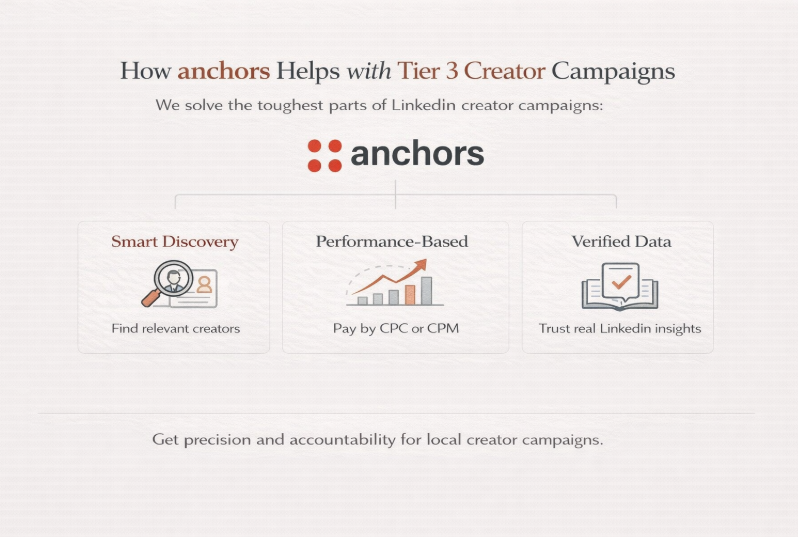
This is where platforms like anchors become useful. anchors helps brands:
- Discover relevant LinkedIn creators beyond obvious metro circles
- Run campaigns in a performance-based model (CPM/CPC style)
- Access verified LinkedIn data instead of manual screenshots
- Treat creator posts more like ads, with predictable tracking
For Tier 3 campaigns especially, this reduces guesswork and makes small experiments easier to justify.
Realistic Mini Examples
Example 1: Regional HR SaaS
Objective: Reach HR managers in non-metro manufacturing hubs.
Creator type: HR leadership creator (~8k followers).
Content angle: “How we handle hiring challenges in smaller cities.”
Success description: Strong comment quality and {{qualified_leads}} from specific regions.
Example 2: Career Upskilling Program
Objective: Drive signups from Tier 3 engineering graduates.
Creator type: Early-career mentor (~11k followers).
Content angle: Personal transition story with practical advice.
Success description: Consistent {{CTR}} and meaningful inbound queries.
7-Day Playbook to Test Tier 3 Creators
- Day 1–2: Define one clear region and one ICP.
- Day 2–3: Shortlist 5–8 nano or micro creators.
- Day 3: Brief creators with context, not scripts.
- Day 4–5: Launch posts with staggered timing.
- Day 6: Review clicks, comments, and audience quality.
- Day 7: Double down on top 2 creators, pause others.
Templates You Can Copy
Creator Brief Template
Audience: [Role + region] Key message: [Problem you solve] Tone: Personal, experience-based CTA: Soft (learn more, explore)
Tracking Checklist
Creator name | City/region | Followers | Post link | Clicks | Comments quality | Leads
Mistakes We’ve Seen Brands Make
- Expecting Tier 1 scale from Tier 3 creators
- Over-branding the content
- Ignoring comment quality
- Running one-off posts with no follow-up
- Not comparing performance across regions
FAQs
Q)Are Tier 3 creators cheaper?
A)Sometimes, but cost should not be the main reason. Relevance matters more.
Q)Should we localize language?
A)Often yes, but even subtle regional context helps.
Q)How many creators should we start with?
A)Start small: 5–8 creators is usually enough to learn.
Q)Can we mix Tier 1 and Tier 3 creators?
A)Yes. This often gives the best balance of scale and trust.
Explore More Articles
Discover our latest insights on SEO, content marketing, and digital strategy. Explore our curated collection of articles to enhance your digital presence.
← Scroll to explore more →